

Governed Snowflakemetrics, live in Power BI and Excel
AtScale for Snowflake Semantic Views extends trusted business definitions from Snowflake Semantic Views to Microsoft Power BI and Excel. Business users get live access to governed Snowflake metrics in the tools they already use, without extracts, mirrored data, or recreated semantic logic.
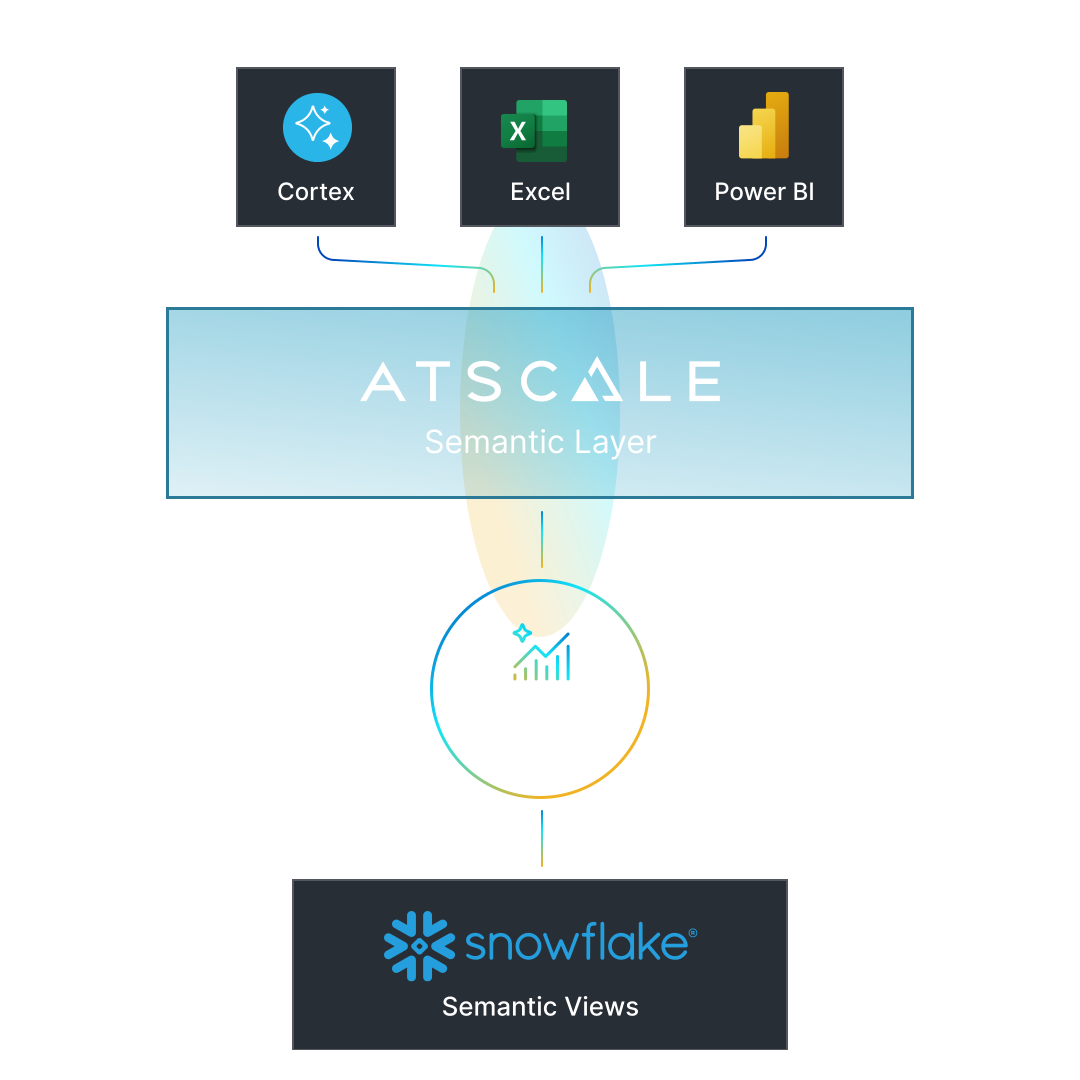
AtScale for Snowflake Semantic Views XMLA Endpoint: Private Preview Coming Soon!
Register Your InterestOne semantic foundation. Zero migration.
Snowflake defines the metrics. AtScale brings them to Microsoft analytics.
Snowflake Semantic Views give teams a governed foundation for business metrics in Snowflake. But many business users still work in Power BI and Excel every day. AtScale connects those experiences, so AI, dashboards, and spreadsheets can operate from the same trusted Snowflake definitions.
What AtScale for Snowflake Semantic Views Enables
Extend Snowflake Semantic Views to Power BI and Excel
Use governed Snowflake metrics directly in Power BI reports and Excel pivot tables.
Keep data and compute in Snowflake
Avoid extracts, duplicated datasets, mirrored data, and unnecessary movement into other analytics platforms.
Preserve Snowflake governance
Respect Snowflake role-based access control and governed access policies tied to Semantic Views.
Deliver consistent answers
Help Snowflake CoWork, CoCo, Power BI, and Excel work from the same metric definitions.
AtScale for Snowflake Semantic Views vs. AtScale Enterprise
Two ways to extend governed semantics from Snowflake.
| Capability | XMLA Endpoint | AtScale Enterprise |
|---|---|---|
| Primary Use Case | Extend Snowflake Semantic Views to Power BI and Excel | Govern metrics across BI, AI, and advanced analytics |
| Best Fit | Snowflake customers using Semantic Views and Microsoft analytics | Teams with broader semantic layer needs |
| Deployment | Snowflake Native App — Enabled with CREATE XMLA DDL commands | Enterprise deployment with customer-managed options through Kubernetes |
| Semantic Model | Snowflake Semantic Views | Snowflake Semantic Views plus Multidimensional semantic models via AtScale SML |
| Modeling Capabilities | Snowflake Semantic Views | AtScale Multi-Dimensional model in SML |
| Microsoft Support | Excel (Live MDX Connection), Power BI (Live DAX Connection) | Advanced Power BI, DAX, MDX, and calculation support |
| Development Environment | Snowflake Snowsight | AtScale Design Center |
| Security and Governance | Snowflake RBAC passthrough; row/column-level security via Snowflake policies | Snowflake security plus semantic object RBAC and authoring permissions in SML |
| AI Support | Supports Snowflake-native AI | Supports MCP, AI agents, BYO LLM, and multi-LLM strategies |
| Performance | Query acceleration for Power BI and Excel workloads | Autonomous aggregates and advanced workload optimization |
| Development Workflow | Snowflake-native workflow | Git-backed, CI/CD-friendly semantic development |
When to Choose
XMLA Endpoint
Choose this edition when your goal is to bring governed Snowflake metrics into Power BI and Excel quickly, without extracts, duplicated logic, or moving data out of Snowflake.
AtScale Enterprise
Choose AtScale Enterprise when your organization needs a full semantic layer across multiple BI tools, AI agents, advanced business calculations, fiscal calendars, hierarchies, Git-backed workflows, or multiple data platforms.
AtScale for Snowflake Semantic Views vs. AtScale Enterprise
Start with Snowflake Semantic Views. Expand when your semantic layer needs grow.
AtScale for Snowflake Semantic Views brings trusted Snowflake definitions to Power BI and Excel without extracts, mirrored data, or duplicated logic. The result: consistent answers across AI, dashboards, and spreadsheets, with data and compute staying in Snowflake.
AtScale Enterprise is the full universal semantic layer for organizations that need advanced modeling, broader tool support, AI agent connectivity, query acceleration, Git-backed development, and multi-cloud flexibility.
Questions? We’ve Got Answers.
How AtScale and Snowflake give you agency over your semantics.
No. Snowflake Semantic Views define metrics inside the warehouse. AtScale carries those same definitions to every BI tool, AI agent, and downstream system the customer also uses – governed, identically, with one definition of truth. Snowflake Ventures led AtScale’s last strategic equity round; the partnership is on the record. Cortex Analyst gets stronger when AtScale is the semantic layer behind it.
Power BI, Tableau, and Looker each ship a tool-specific semantic layer. None of them are universal – they only govern their own tool. The moment a Cortex agent, a Claude agent, or an Excel user asks the same question, the answers diverge. AtScale is the universal layer that sits above Cortex and below everything else, so the same revenue number lands in every tool.
Snowflake embeds the AtScale engine directly inside Snowflake Semantic Views – AtScale makes Snowflake Semantic Views available to Power BI and Excel without moving data out of Snowflake. Beyond that, Snowflake Ventures led AtScale’s last strategic equity round in February 2026. The partnership is strategic, not just commercial. Harsha Kapre, Head of Snowflake Ventures, stated: “As organizations continue to centralize data in Snowflake, partnering with AtScale helps our joint customers maintain consistent business logic and semantic definitions throughout their analytics and AI workflows.”
AtScale ships in two editions that share one semantic foundation:
Snowflake Semantic Views XMLA Endpoint, Powered by AtScale
The same semantic foundation extended to every BI tool (Tableau, Excel, Looker), every AI agent (Claude, ChatGPT, custom MCP agents), and every warehouse (Databricks, BigQuery, Redshift, on-prem). No rip-and-replace. No migration.
AtScale Enterprise
The same semantic foundation extended to every BI tool (Tableau, Excel, Looker), every AI agent (Claude, ChatGPT, custom MCP agents), and every warehouse (Databricks, BigQuery, Redshift, on-prem). No rip-and-replace. No migration.
AtScale synchronizes Snowflake Semantic Views definitions automatically for XMLA access in Power BI and Excel. The definitions your team built inside the warehouse are now portable – they travel to Power BI, Tableau, Excel, and AI agents without redefinition. You keep the work your team has already done; AtScale extends its reach.
AtScale supports any tool that speaks SQL or XMLA. That includes Power BI (DirectQuery and Live Connection), Tableau, Excel, Looker, ThoughtSpot, and any SQL-compatible analytics tool. Embedded AtScale supports Power BI and Excel. Enterprise AtScale extends to the full tool universe.
AtScale typically reduces Snowflake compute costs for BI workloads by 40-70%. The primary mechanism is aggregate caching – pre-computing common metrics so that dashboard queries serve from a cache instead of scanning large tables. Intelligent warehouse routing (sending complex queries to appropriately sized warehouses) further reduces costs while improving performance.
Embedded AtScale deploys from the Snowflake Marketplace with a single DDL command. From installation to first governed query is typically minutes to hours. Enterprise AtScale deployments vary based on the complexity of the semantic model being built, but customers typically have their first governed use case live within 2-4 weeks.
No. AtScale connects to Snowflake (and any other warehouses in Enterprise edition) without moving data. Your data stays where it lives. AtScale creates a semantic layer on top of it – a governed definition layer, not a data store.
The XMLA Endpoint does not integrate directly with CoCo.
AtScale Enterprise can support CoCo through AtScale's MCP Server and SQL-based access patterns. CoCo sends natural language queries to AtScale's semantic layer, which resolves the business intent against governed metric definitions and generates optimized Snowflake SQL. The result: CoCo answers using the same business definitions as Power BI and every other tool in the stack – no divergence, no trust problems.
Enterprise AtScale includes MCP (Model Context Protocol) server access that makes the semantic layer available to Claude, ChatGPT, and any custom AI agent built on the MCP standard. AI agents get governed business definitions – revenue, margin, customer segments – delivered via the MCP protocol. This is the architecture that makes AI agents trustworthy: they don't infer business meaning; they use the governed definition.
